When Larry Burkett started Christian Financial Concepts (now Crown Financial Ministries) 50 years ago he was very concerned about America’s spiralling debt. He was particularly concerned about runaway United States federal government debt. Those trends have got worse, especially for federal government debt, which is now estimated to be US$40 trillion. In fiscal year 2026 US federal government revenue was US$5.4 trillion while spending was US$7.4 trillion. That added nearly US$2.0 trillion to federal government debt in one year. As of September 2026, net interest cost on the debt was US$1.0 trillion. That was 14% of total federal government spending in fiscal year 2026 [1].
A key conversation in the 2026 New Zealand elections has been the size of New Zealand government debt and the impact of that on future affordability for New Zealand superannuation. Central Government debt in New Zealand hasn’t increased to the extent that it has in the United States. However, there has been a massive increase in New Zealand households housing and consumer debt. It has increased from $21 billion in December 1990 to $416 billion in July 2026 [2] .
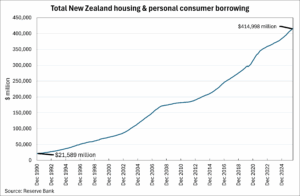
The Bible and Money
We may never be able to change the course of massive government overspending and borrowing, but we can advocate for more Christian leaders to equip others to learn and apply God’s financial principles. The Bible addresses every aspect of every area of handling money. God used more than 2,350 verses in His Word to instruct us in His principles of earning, giving, saving, spending, investing, getting out of debt, and teaching children how to handle money. Yet most Christians are unaware of the biblical principles because they were not taught them.
In Matthew 28:18–20, Jesus issued the Great Commission: “All authority in heaven and on earth has been given to me. Go therefore and make disciples of all nations, baptizing them in the name of the Father and of the Son and of the Holy Spirit, teaching them to observe all that I have commanded you. And behold, I am with you always, to the end of the age.”
After evangelizing the nations, the second command is, “teaching them to observe all that I commanded you.” This has been largely ignored with respect to one of the most addressed subjects in the ministry of Jesus: God’s financial principles. Spiritual leaders must take seriously the command to make disciples by teaching people all that He taught. His financial principles are essential for our freedom from the control of money and for the perpetuation of the Church.
The Core Lesson
Most Christians believe that the Lord has no part in their finances. But Scripture reveals that He plays the central role as owner of all things. Psalm 24:1 says: “The earth is the Lord’s and everything in it. The world and all its people belong to him” (NLT).
Any financial teaching in the church is usually confined to handling the tithe, or 10% of one’s income. Although this is crucial, most believers do not understand the reason for giving or the Lord’s perspective for handling the other 90%. That remaining money is perceived to be theirs to use as they please. Nothing could be further from the truth.
All income, assets, and possessions belong to God; we own nothing. We are merely stewards, or managers, of what belongs to Him. Hence, we do not have the liberty to spend as we might desire. He has granted us the tremendous responsibility to manage things in a way that would please Him.
If we are to effectively present the message of the Great Commission, we cannot fail to address the subject of financial stewardship. Failing to teach the full counsel of God’s Word on biblical financial stewardship omits a major segment of Jesus’ command. A look at America’s debt levels shows the need for education in our churches and our homes.
Proverbs 22:7 has been ignored: “Just as the rich rule the poor, so the borrower is servant to the lender.” So has Deuteronomy 15:6, which was given to the nation of Israel: “The Lord will bless you as he has promised. You will lend to many nations but will never need to borrow. You will rule many nations but they will not rule over you.”
What Can We Do?
To insulate yourself against the economic threats created by excessive debt, be sure to minimize or eliminate your personal debt as much as possible. The less you owe, the freer you become.
Place your faith and confidence in God’s hands and avoid worrying about the condition of the economy. God will be with us in a good economy or a bad economy.
Pray that our churches, spiritual leaders, and godly parents will teach Biblical financial principles in order to raise up faithful stewards who will be free to work, give, save, spend, and invest in ways that will grow God’s Kingdom.
Let’s remember that biblical stewardship is not being free to spend money however we want; it is being free for God to spend us however He wants.
Crown has many free resources to help: online courses, Bible studies, articles and access to online financial tools.
References
[1] https://fiscaldata.treasury.gov/americas-finance-guide/national-debt/#key-takeaways [2] https://www.rbnz.govt.nz/statistics/series/lending-and-monetary/registered-banks-and-non-bank-lending-institutions-sector-lendingMore Articles and Online Tools To Inspire You
How does God’s financial advice compare with the worlds?
Ten keys to financial freedom.
Debt Free Living online course (free)
Help me get our spending under control.
